Choosing the right material for your custom built-ins is the single most critical decision in the remodeling process. According to industry data from the National Association of Realtors, home improvement projects that enhance storage and organization can increase property value by up to 10% in competitive markets like Tampa Bay. This statistic highlights that built-ins are not merely decorative; they are strategic investments in your home's structural utility and long-term worth. The material you select will dictate the lifespan, maintenance requirements, and visual character of the installation.
Solid Wood: The Premium Standard
Solid wood remains the gold standard for high-end residential built-ins. It offers unmatched durability and a natural grain pattern that cannot be replicated by synthetic materials. When we discuss solid wood, we are referring to lumber that is cut directly from the log, providing structural integrity that stands the test of time.
Common Species for Cabinetry
Not all woods are created equal. The choice of species affects both the cost and the performance of your built-ins. Oak, maple, and cherry are the most popular choices for custom cabinetry in Florida homes. Oak provides a hard, durable surface that resists wear. Maple offers a fine, uniform grain that takes paint exceptionally well. Cherry develops a rich, dark patina as it ages, adding character to the space over decades.
Solid wood is defined as lumber that is 100% natural timber with no composite layers. This definition is crucial because it distinguishes premium craftsmanship from engineered alternatives. At Remodel Depot, we utilize premium materials to ensure that every piece we craft is built to last. Our commitment to quality means we select wood that has been properly dried and seasoned to prevent warping in Florida's humid climate.
The primary advantage of solid wood is its repairability. If a dent or scratch occurs, a professional can sand and refinish the area seamlessly. This longevity makes solid wood an excellent choice for heirloom-quality furniture pieces that you intend to keep for generations. However, this premium performance comes with a higher price point and a need for careful environmental control to prevent expansion and contraction.
Plywood: The Structural Workhorse
Plywood is often misunderstood as a lower-quality alternative, but high-grade plywood is the backbone of professional cabinet construction. It is made by gluing together thin layers of wood veneer, with each layer oriented perpendicular to the one below it. This cross-grain construction provides exceptional strength and stability.
Plywood is defined as a panel product made from three or more layers of wood veneer bonded with adhesive. This structural definition explains why it is less prone to shrinking, swelling, and cracking compared to solid wood. For the internal carcasses of built-ins, plywood is often the superior choice because it holds screws and hardware more securely than particle board or lower-grade composites.
Grade Matters
Not all plywood is suitable for visible built-ins. You must distinguish between utility-grade plywood and cabinet-grade plywood. Cabinet-grade plywood uses higher-quality veneers with fewer voids and a smoother surface. It is often made from tropical hardwoods like birch or maple, providing a beautiful surface that can be stained or painted.
Using high-quality plywood for the structural components of your built-ins allows you to save costs on visible faces while maintaining structural integrity. This hybrid approach is common in professional remodeling. It ensures that the shelves do not sag under heavy loads and that the cabinet doors remain aligned over time. For commercial remodeling projects, such as office built-ins, plywood offers the durability needed for high-traffic environments.
MDF: The Smooth Canvas
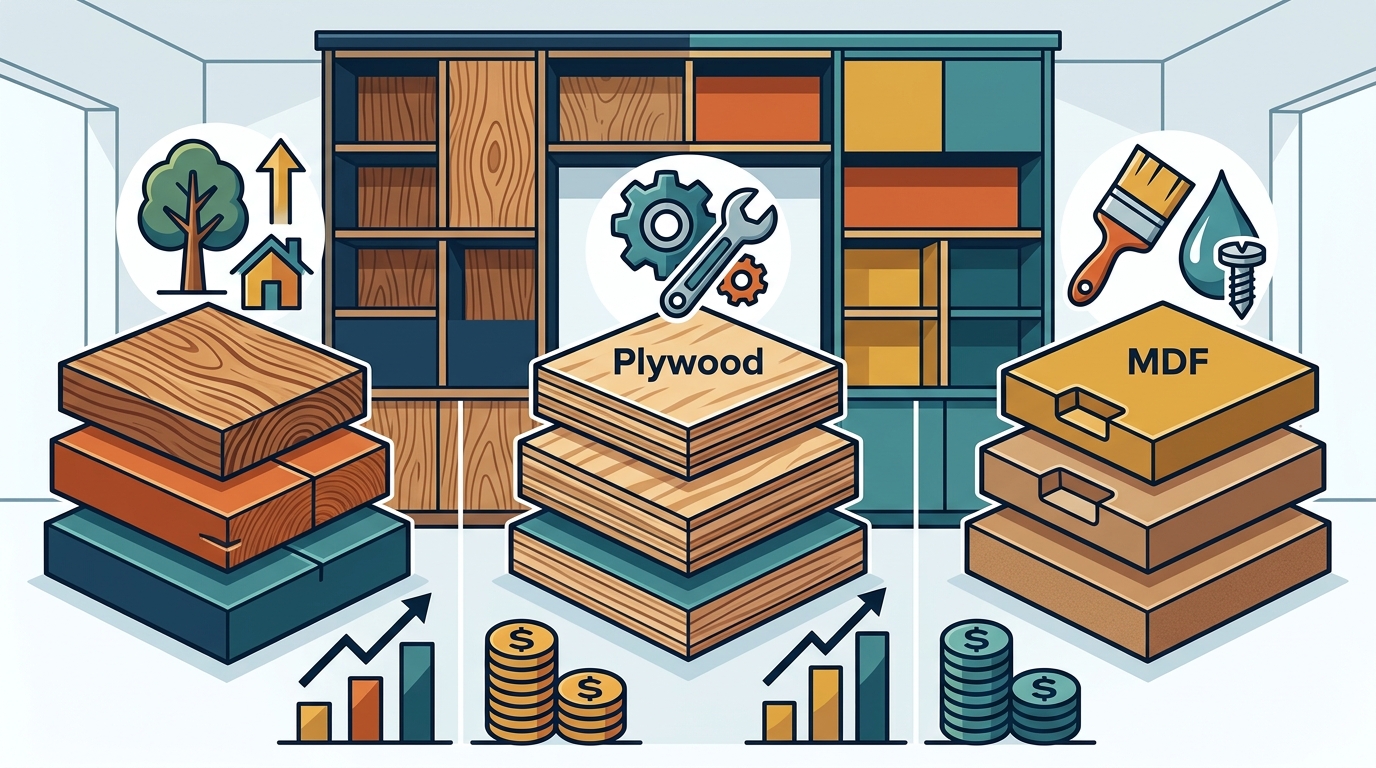
Medium Density Fiberboard (MDF) is an engineered wood product made by breaking down hardwood or softwood residuals into wood fibers. These fibers are combined with wax and a resin binder, then formed into panels by applying high temperature and pressure. The result is a dense, uniform material with no grain or knots.
MDF is defined as an engineered panel product composed of wood fibers bonded with resin under heat and pressure. This manufacturing process creates a surface that is perfectly smooth, making it ideal for painted finishes. When you choose a painted white or bold color for your entertainment center, MDF provides a flawless backdrop that hides imperfections better than solid wood.
Pros and Cons of MDF
The primary advantage of MDF is its cost-effectiveness and ease of machining. It cuts cleanly, allowing for intricate profiles and detailed molding work. This makes it a favorite for custom entertainment centers and bookcases with complex architectural details. However, MDF has significant drawbacks. It is heavy, which requires robust support structures. It is also susceptible to water damage. If exposed to moisture, MDF can swell and disintegrate, making it unsuitable for bathrooms or areas with high humidity unless properly sealed.
For residential settings in Tampa Bay, where humidity is a constant factor, MDF must be used with caution. It is best reserved for interior rooms with controlled climate conditions. When used correctly, it offers a smooth, durable surface that resists warping better than many solid woods in stable environments.
Material Comparison Matrix
Understanding the differences between materials is essential for making the right choice. The table below summarizes the key characteristics of each material type.
| Material | Durability | Cost | Best For | Maintenance |
|---|---|---|---|---|
| Solid Wood | Very High | High | Heirloom pieces, visible faces | Periodic refinishing |
| Cabinet-Grade Plywood | High | Medium | Structural carcasses, shelves | Low |
| MDF | Medium | Low | Painted finishes, intricate details | Keep dry, touch-up paint |
| Particle Board | Low | Very Low | Temporary or budget projects | Avoid moisture |
This comparison highlights that there is no single "best" material. The optimal choice depends on your budget, aesthetic goals, and the specific room conditions. For example, a kitchen pantry might benefit from plywood carcasses with solid wood doors, while a bedroom closet might use MDF for painted shelves.
Key Takeaways
- Solid wood offers the highest durability and resale value but comes at a premium cost.
- Cabinet-grade plywood provides superior structural stability and is ideal for hidden components.
- MDF is the best choice for painted finishes due to its smooth, knot-free surface.
- Florida humidity requires careful material selection to prevent warping and swelling.
- Hybrid approaches, such as plywood carcasses with wood faces, offer a balanced cost-to-quality ratio.
- Professional installation is critical to ensure proper sealing and alignment of any material.
- Remodel Depot uses FL License #CGC1504088 to ensure all projects meet state safety standards.
Frequently Asked Questions
Which material is best for a humid environment like Tampa?
Cabinet-grade plywood and properly sealed solid wood are the best choices for humid environments. MDF should be avoided in areas with high moisture, such as bathrooms, unless it is specifically designed for wet conditions.
Can I paint MDF built-ins?
Yes, MDF is excellent for painting. Its smooth surface allows for a flawless finish without the grain showing through. However, you must seal the edges thoroughly to prevent moisture absorption.
Is solid wood worth the extra cost?
For permanent fixtures that you plan to keep for decades, solid wood is worth the investment. It can be refinished multiple times and adds significant aesthetic value to your home.
What is the difference between particle board and MDF?
Particle board is made from larger wood chips and is less dense and weaker than MDF. MDF is made from fine fibers and offers a smoother, stronger surface for cabinetry.
How do I maintain wooden built-ins?
Regular dusting and occasional polishing with appropriate wood cleaners will maintain the finish. Avoid using excessive water or harsh chemicals that can damage the wood or finish.
Do I need a licensed contractor for built-ins?
While small projects can be DIY, large structural built-ins often require a licensed general contractor to ensure they are safe, level, and properly integrated with your home's structure.
Start Your Custom Project
Choosing the right material is just the first step in creating a beautiful, functional space. At Remodel Depot, we combine traditional woodworking skills with modern techniques to deliver precision craftsmanship. Whether you need custom cabinetry, built-in shelving, or a complete home office transformation, our team is ready to bring your vision to life.
As a licensed Florida General Contractor, we provide the protection and professionalism you deserve. We serve residential and commercial clients throughout the Tampa Bay area. Contact us today to schedule a consultation and discuss your project needs. Visit our services page to learn more about our offerings. You can also view our portfolio of custom work to see our craftsmanship in action.
Ready to transform your space? Request a free estimate or call us at 813-549-CITY. Let us help you build something beautiful that lasts for generations.